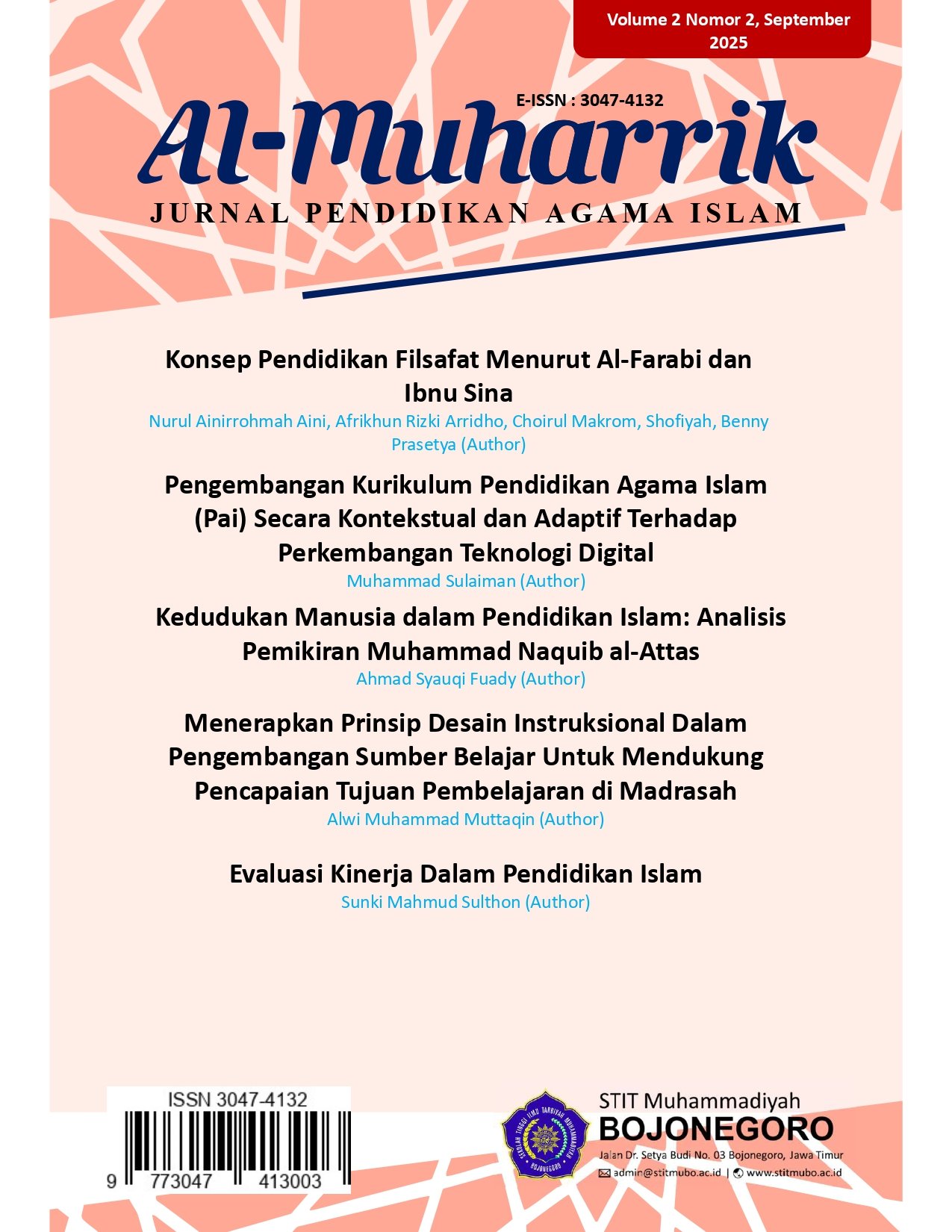
KONSEP PENDIDIKAN FILSAFAT MENURUT AL-FARABI DAN IBNU SINA
DOI:
https://doi.org/10.59829/1s5jkh80Keywords:
Philosophy Education, Al-Farabi, Ibnu SinaAbstract
This study aims to conduct a comparative and integrative analysis of the educational philosophies of Al-Farabi and Ibn Sina within the framework of Islamic educational thought. Both philosophers view education as a means of achieving human perfection (kamāl al-insān) through the integration of rational and spiritual dimensions. The research employs a literature study using an integrative review model combined with descriptive qualitative analysis. The findings reveal that Al-Farabi emphasizes education as a rational and moral process leading to the development of the active intellect and the establishment of a virtuous society (al-madīnah al-fāḍilah), while Ibn Sina conceptualizes education as the purification of the soul (tazkiyah al-nafs) toward true happiness (sa‘ādah). The synthesis of both perspectives forms a holistic paradigm of Islamic education that integrates logic, ethics, and metaphysics as the foundation for the formation of the complete human being (insān kāmil). This study highlights the importance of recontextualizing Al-Farabi’s rationalism and Ibn Sina’s spiritualism in developing modern Islamic educational curricula. Practically, the findings provide a philosophical foundation for an educational model that balances intellectual intelligence, moral integrity, and spiritual depth, positioning Islamic education as a transformative process toward knowledgeable, virtuous, and God-conscious individuals.
Downloads
Downloads
Published
Issue
Section
License
Copyright (c) 2026 Nurul Ainirrohmah Aini, Afrikhun Rizki Arridho, Choirul Makrom, Shofiyah, Benny Prasetya (Author)

This work is licensed under a Creative Commons Attribution 4.0 International License.



 STIT Muhammadiyah Bojonegoro